Continent Guide

Discover Australia

The world's oldest living continent — a place of ancient geological wonder, extraordinary biodiversity, iconic cities, and one of humanity's oldest continuous cultures stretching back over 65,000 years.

Overview

Australia: A Land of Contrasts

Australia is the world's sixth-largest country by total area, yet one of its least densely populated. Stretching across 7.7 million square kilometres, it encompasses every conceivable landscape: tropical rainforests, alpine meadows, sun-baked red deserts, lush wine regions, and thousands of kilometres of pristine coastline.

The Aboriginal and Torres Strait Islander peoples have lived on this continent for at least 65,000 years — making their culture one of the oldest continuous civilisations on Earth. Exploring Australia means engaging with this profound heritage alongside its dynamic modern cities, world-class food and wine scene, and extraordinary natural wonders.

From the tropical north of Queensland and the Northern Territory to the temperate south of Victoria and Tasmania, each region of Australia offers its own distinct character, climate, wildlife, and experiences.

Plan Your Australia Trip
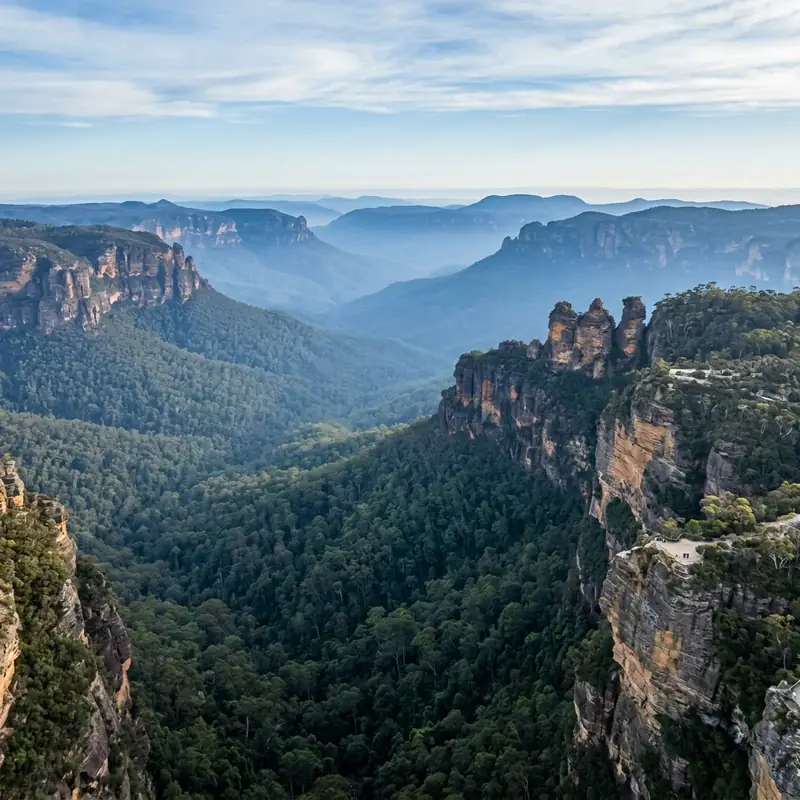
Blue Mountains NSW with Three Sisters rock formation
7.7M
Square Kilometres
20
UNESCO Heritage Sites
10,000
Beach Destinations
65k
Years of Indigenous Culture
New South Wales

Sydney — Australia's Harbour City

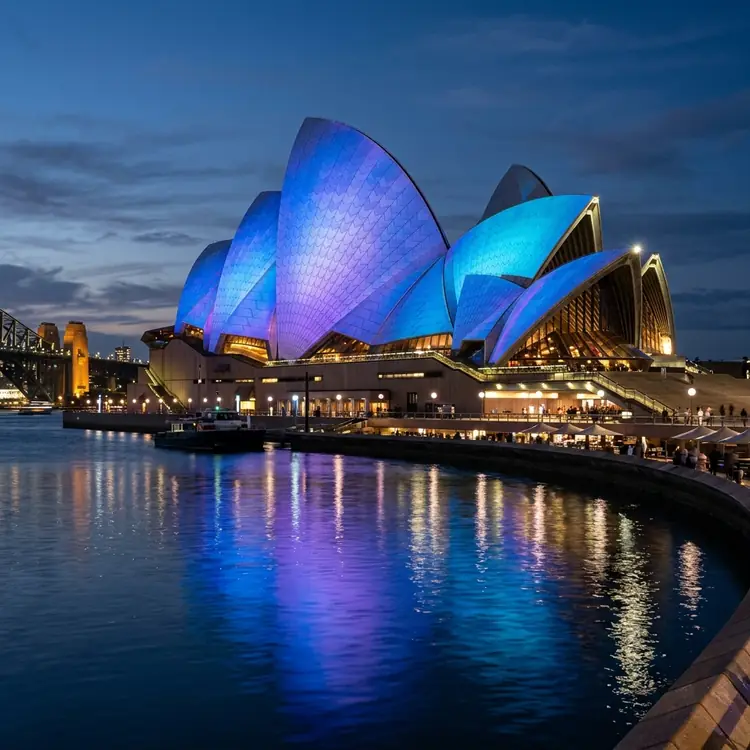
Sydney is one of the world's most beautiful and liveable cities, built around one of the planet's finest natural harbours. The Opera House and Harbour Bridge form an iconic duo recognised instantly around the globe.

Sydney Opera House at night with blue lighting

Sydney Opera House

Designed by Danish architect Jorn Utzon and completed in 1973, the Sydney Opera House is among the most distinguished buildings of the 20th century. Its distinctive shell-shaped roof structures — technically referred to as shells — remain an engineering marvel decades after construction.

Recognised as a UNESCO World Heritage Site in 2007, the Opera House hosts over 1,500 performances annually, attracting more than 8 million visitors. Guided tours reveal the building's fascinating construction history and extraordinary interior spaces.

Sydney Harbour & Bondi Beach

Sydney Harbour offers world-class sailing, kayaking, and ferry cruises between its many bays and headlands. The iconic Harbour Bridge can be climbed for panoramic views — a bucket-list experience offered at sunrise, daytime, twilight, and night.

Bondi Beach, just 8 kilometres from the CBD, is one of the world's most famous surf beaches. The Bondi to Coogee coastal walk (6km) passes through a series of stunning bays and rock pools, showcasing Sydney's spectacular sandstone coastline.

Blue Mountains

Just 80 kilometres west of Sydney, the Blue Mountains National Park encompasses over 267,000 hectares of deep gorges, eucalyptus forest, and dramatic escarpments. The Three Sisters rock formation at Echo Point is the park's signature viewpoint, best visited at dawn when the valley fills with a distinctive blue haze created by eucalyptus oil droplets.

The Scenic World complex offers a cable car, scenic railway (claimed to be the world's steepest), and walking trails through ancient rainforest to the valley floor. The heritage town of Katoomba is the gateway to the mountains with excellent cafes, restaurants, and accommodation.
Queensland

Queensland — The Sunshine State

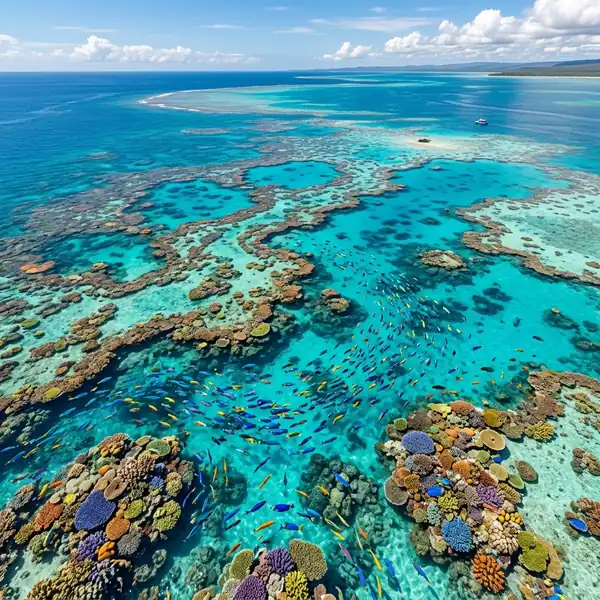
Queensland is Australia's adventure heartland, home to the Great Barrier Reef, ancient rainforests, and the world-famous Whitsunday Islands. With over 300 days of sunshine per year, Queensland lives up to its nickname.

Great Barrier Reef aerial view
Marine Park

Great Barrier Reef

The world's largest coral reef system spans over 2,300km and contains over 900 islands. Home to 1,625 fish species, 3,000 types of mollusc, 630 types of echinoderm, and 215 species of birds. Dive or snorkel from Cairns, Port Douglas, or the Whitsundays.

Full Guide
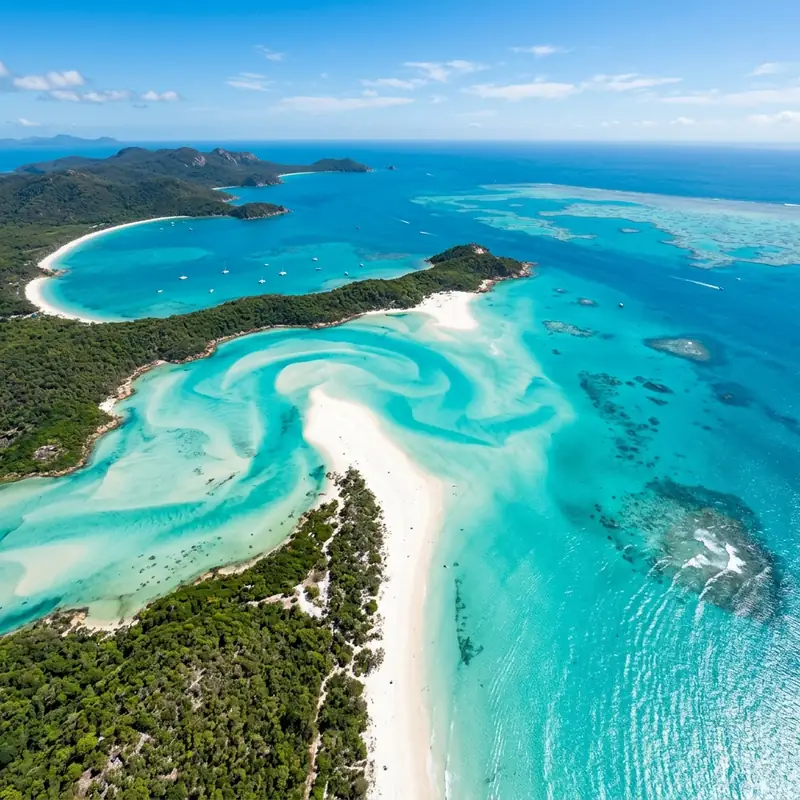
Whitehaven Beach aerial view with turquoise swirling water
Islands

Whitsunday Islands

74 islands scattered in the heart of the Great Barrier Reef Marine Park. Whitehaven Beach — with its pure silica sand and swirling turquoise waters — consistently ranks among the world's top beaches. Accessible by boat, seaplane, or helicopter from Airlie Beach.

Full Guide
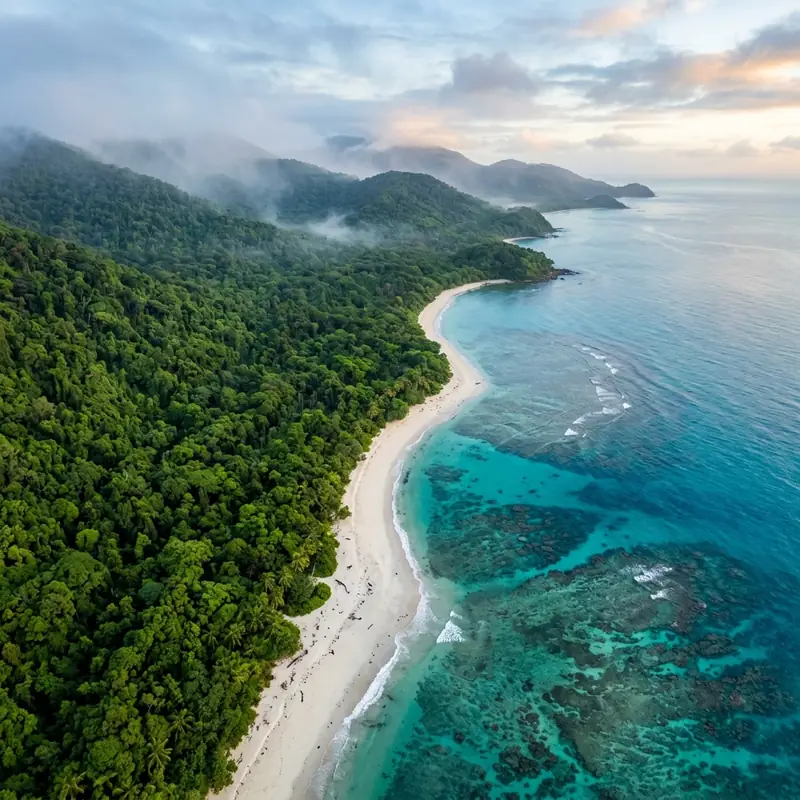
Daintree Rainforest coastline from aerial view
World Heritage

Daintree Rainforest

The Daintree is the world's oldest continuously surviving tropical rainforest, estimated at over 135 million years old. In this unique area, tropical rainforest meets the Great Barrier Reef — two UNESCO World Heritage Areas in one remarkable place north of Cairns.

Full Guide
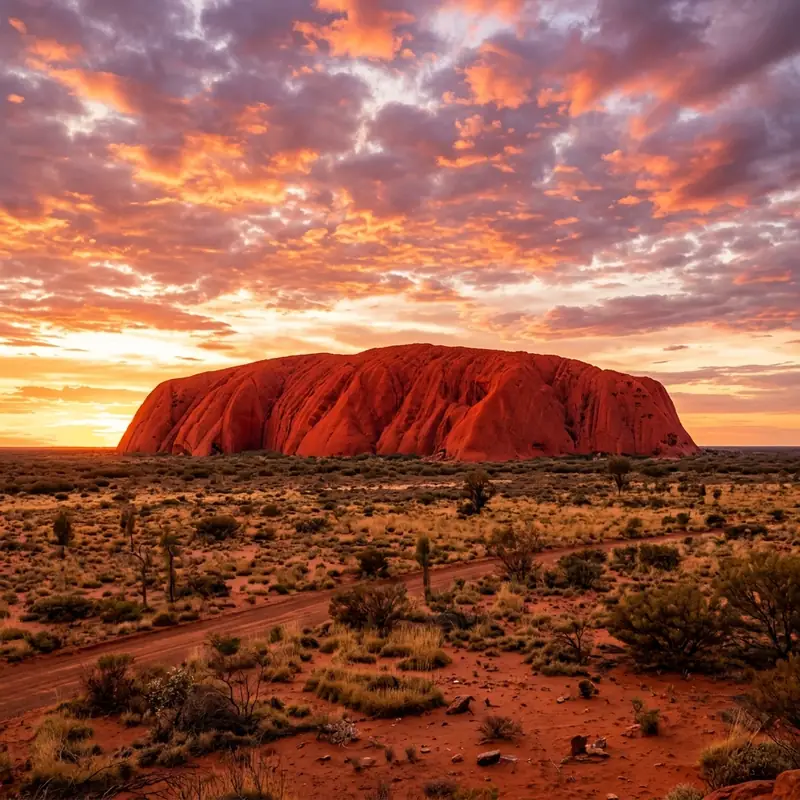
Uluru glowing red at sunset in the Northern Territory
Northern Territory

Uluru & the Red Centre

Uluru (also known as Ayers Rock) rises 348 metres from the flat desert plain of Australia's Red Centre. This massive sandstone monolith measures 9.4 kilometres in circumference and extends an estimated 2.5 kilometres below the earth's surface.

Sacred to the Anangu people — the traditional custodians of the land — Uluru is one of Australia's most recognisable and spiritually significant landmarks. The rock changes colour dramatically throughout the day, glowing bright orange and red at sunrise and sunset.

Nearby Kata Tjuta (the Olgas) is another extraordinary formation of 36 domed rock formations, including the Valley of the Winds walk — one of Australia's finest hiking experiences. The UNESCO World Heritage-listed Uluru-Kata Tjuta National Park surrounds both sites.

The climb to the summit of Uluru was permanently closed in October 2019, respecting the wishes of the Anangu people. Cultural tours, guided walks, and the Field of Light art installation provide respectful and enriching ways to experience this sacred landscape.

Detailed Guide Plan This Visit
Victoria

Great Ocean Road

One of the world's most spectacular coastal drives, the Great Ocean Road stretches 243 kilometres along Victoria's southwest coast, passing towering sea stacks, ancient rainforests, and charming seaside towns.

The Great Ocean Road was built by returned soldiers between 1919 and 1932 as a memorial to those who had died in the First World War — making it the world's largest war memorial. The road hugs the coastline, offering dramatic views of the Southern Ocean at every turn.

The Twelve Apostles — a collection of limestone stacks rising from the ocean — are the road's most photographed landmark. Though only eight stacks remain standing today (erosion is constant), the sight of these columns emerging from the surf is genuinely awe-inspiring.

Other highlights include Loch Ard Gorge, London Arch, the Arch, and the Grotto. Inland, the Otway Rainforest offers canopy walks, waterfalls, and the chance to spot wild koalas in their natural habitat.

Drive Duration

Allow 2–3 days from Melbourne for a comfortable journey with stops.

Best Viewpoint

Visit the Twelve Apostles at sunrise or sunset for the most dramatic light and fewer crowds.

Start Point

The road begins at Torquay, 95km from Melbourne CBD, and ends at Allansford near Warrnambool.

Wildlife

Look for wild koalas in the Otway Ranges (particularly between Kennett River and Apollo Bay), kangaroos, echidnas, and hundreds of bird species.

Surf Towns

Torquay hosts Bells Beach — venue for the world's longest-running professional surf competition — and the Australian Surf Museum.

Best Season

Spring (Sept–Nov) and autumn (March–May) offer mild temperatures and smaller crowds than summer.

Island State

Tasmania — Australia's Natural Gem

Tasmania is Australia's island state — a rugged wilderness destination that holds more World Heritage wilderness per capita than any other place on Earth. It is also home to extraordinary food, wine, and arts culture.

National Park

Cradle Mountain

The iconic jagged peak of Cradle Mountain rises above Lake Dove in the Tasmanian Wilderness World Heritage Area. The Overland Track (65km) is one of Australia's greatest multi-day hikes, passing through ancient rainforest, glacial lakes, and alpine moorland.

History

Port Arthur

One of Australia's most significant heritage sites, Port Arthur was a convict settlement from 1830 to 1877. The remarkably preserved ruins tell the story of Australia's colonial history. Evening ghost tours add a spine-chilling dimension to the site's dark history.

Arts & Food

Hobart

Tasmania's capital is a vibrant city built around one of the Southern Hemisphere's finest natural harbours. MONA (Museum of Old and New Art) is one of the world's most provocative private art museums. The Salamanca Markets run every Saturday morning.

Far North Queensland

Daintree Rainforest

The Daintree Rainforest is part of the Wet Tropics of Queensland World Heritage Area — a region recognised as one of the most significant natural places on Earth. At over 135 million years old, it pre-dates the Amazon by tens of millions of years.

The Daintree River separates the coastal lowlands from the rainforest-covered ranges. Crocodile-spotting cruises on the river are a popular activity. Beyond the river crossing, Cape Tribulation is where the rainforest literally meets the reef — a unique convergence of two World Heritage sites.

The forest contains species found nowhere else on Earth, including the Cassowary — a large, colourful, and rather intimidating flightless bird. Look out for extraordinary birdlife, tree kangaroos, and a staggering diversity of plant species as you walk the elevated boardwalks.

Plan Daintree Visit
Daintree rainforest meeting the ocean beach
Travel Information

Practical Australia Guide

Everything you need to know before you land.

Visa & Entry

Most visitors require an Electronic Travel Authority (ETA) or eVisitor visa, both available online at immi.homeaffairs.gov.au. Some nationalities require a full tourist visa applied at an Australian embassy.

Getting There

Sydney (SYD), Melbourne (MEL), Brisbane (BNE), and Perth (PER) are the main international gateways. Direct flights from the US, UK, and Asia are common. Flight time from London is approximately 22 hours.

Accommodation

Australia offers accommodation for every budget, from world-class luxury hotels to boutique guesthouses, campervans, and backpacker hostels. Book well in advance for popular destinations during peak season (Dec–Jan).

Health & Safety

Australia has excellent public health infrastructure. Travel insurance is strongly recommended. Bring prescription medication with documentation. Tap water is safe to drink throughout the country.

When to Visit

Australia is an all-year destination but timing depends on region. The tropical north is best visited April–October (dry season). The southeast is pleasant year-round, while summer brings fire risk to inland areas.

Connectivity

Major carriers Telstra, Optus, and Vodafone offer prepaid SIM cards from approximately AUD $30 for unlimited data. Coverage is excellent in cities and coastal areas, but can be limited in remote outback regions.