Complete Guide

All Attractions

Detailed visitor guides for Australia and New Zealand's most iconic landmarks, natural wonders, and cultural destinations — everything you need to plan an unforgettable journey.

Australia

Australia's Iconic Attractions

From the sacred heart of the Red Centre to the living coral cathedral of the Great Barrier Reef, these are Australia's most extraordinary places.
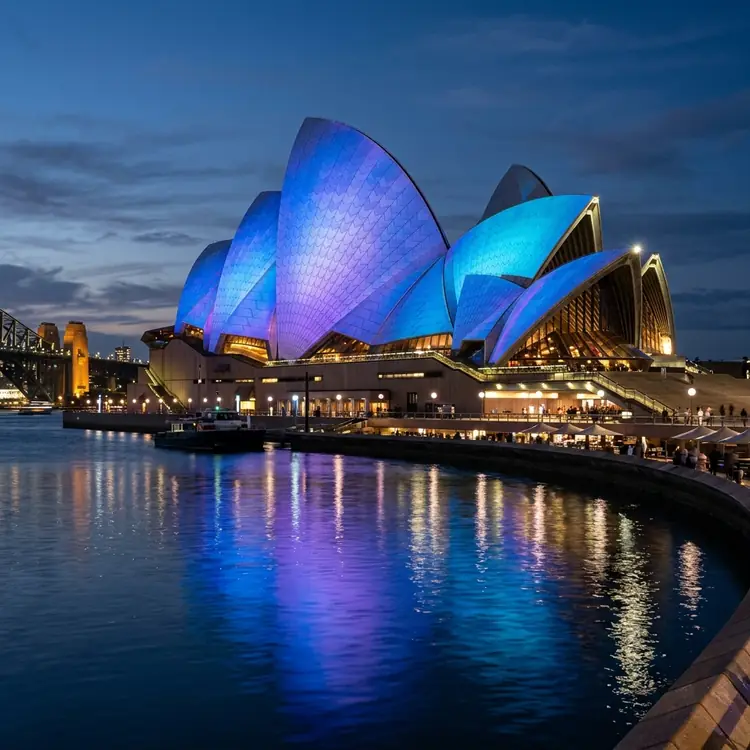
Sydney Opera House illuminated blue at night

Sydney Opera House

The Sydney Opera House is one of the 20th century's greatest works of architecture and one of the most recognisable buildings on Earth. Designed by Danish architect Jorn Utzon, it took 14 years to build (1959–1973) and opened to the world on 20 October 1973.

Utzon's original design was selected from 233 entries submitted by architects from 32 countries. His bold vision — concrete shells clad in over a million ceramic tiles — was initially dismissed as unbuildable. The engineering challenges that arose during construction led to Utzon's resignation in 1966, before the building was completed. He never visited the finished work.

What to See & Do

  • Attend a performance — opera, ballet, symphony, jazz, or contemporary theatre
  • Take the guided backstage tour (90 minutes) to access areas closed to the public
  • Dine at Bennelong restaurant inside the Opera House with harbour views
  • Photograph from the Royal Botanic Garden for the classic Opera House and Bridge composition
  • Visit the forecourt — free entry at all times — to appreciate the architecture up close

Visitor Information

  • Open daily from 9am; tours run 9am–5pm
  • Located at Bennelong Point, Sydney CBD; 15-minute walk from Circular Quay station
  • Adult tour ticket: approx. AUD $45; performance tickets from AUD $50
  • Accessible entry on the eastern side of the building (level access from forecourt)
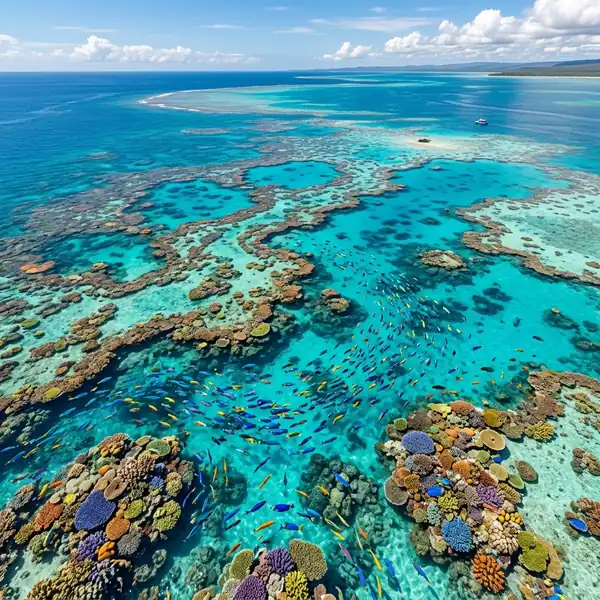
Great Barrier Reef from above with colorful coral and fish

Great Barrier Reef

The Great Barrier Reef is the world's largest coral reef ecosystem, composed of over 2,900 individual reefs and 900 islands stretching for 2,300 kilometres. So vast it can be seen from outer space, it is the world's biggest single structure made by living organisms.

The reef supports an astonishing diversity of life: over 1,625 species of tropical fish, 4,000 types of mollusc, 240 species of birds, 6 of the world's 7 marine turtle species, and 30 species of whales and dolphins. It is one of the planet's most complex and delicate ecosystems.

Best Ways to Experience the Reef

  • Day trips from Cairns or Port Douglas with certified reef operators (snorkelling and diving)
  • Liveaboard dive trips for extended time on the outer reef
  • Scenic helicopter flights for the aerial perspective — Heart Reef is iconic
  • Glass-bottom boat tours for non-swimmers
  • Snorkelling at the Whitsunday Islands — excellent reef accessibility without heavy crowds

Conservation Note

The Great Barrier Reef faces significant threats from climate change, ocean acidification, and agricultural runoff. Choose reef operators certified by the Great Barrier Reef Marine Park Authority. Apply reef-safe sunscreen (free from oxybenzone and octinoxate) to protect coral.
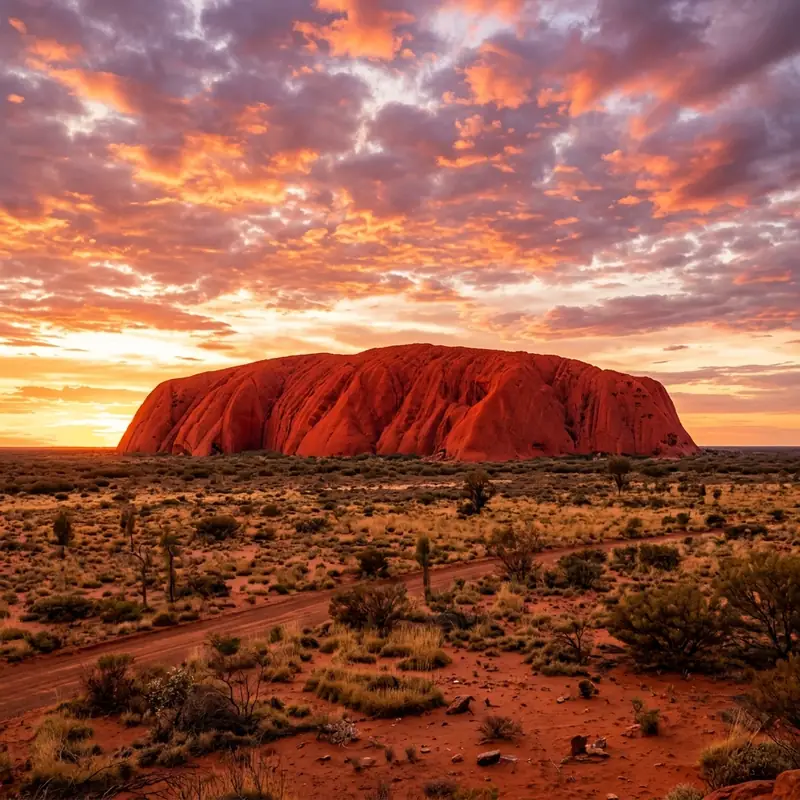
Uluru glowing red-orange at sunset

Uluru

Uluru (formerly known as Ayers Rock) is a massive inselberg of arkosic sandstone in the Uluru-Kata Tjuta National Park, in Australia's Northern Territory. It rises 348 metres above the surrounding flat plain and measures 9.4 kilometres in circumference.

Geologically, Uluru is the tip of a vast underground rock formation that extends an estimated 2.5 kilometres below the surface. The rock's reddish colour is due to oxidation of iron-bearing minerals on its surface. Its true colour — when freshly broken — is a grey-blue.

Sacred Significance

Uluru is sacred to the Pitjantjatjara people (known as Anangu), the traditional custodians of this land. It is directly linked to the Tjukurpa — the Anangu law, religion, and way of life. The Anangu share their stories and knowledge of Uluru through guided cultural tours, but ask that certain sites and stories remain private and are not photographed.

What to See & Do

  • Sunrise and sunset viewing areas (free) — the colour changes are extraordinary
  • Base walk (10.6km circuit, approximately 3.5 hours) around the full perimeter
  • Cultural guided tours with Anangu guides, sharing traditional knowledge
  • Field of Light installation by Bruce Munro (seasonal — check for current dates)
  • Kata Tjuta — the Olgas — 16km away: Valley of the Winds walk (7.4km, 3 hours)
Queensland Islands

Whitsunday Islands

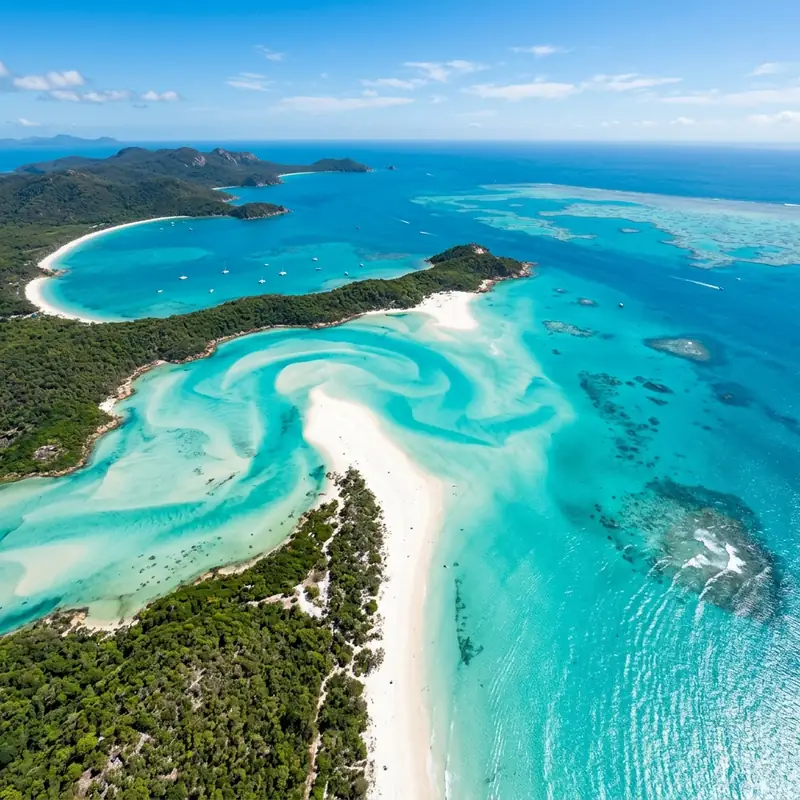
Whitehaven Beach Whitsunday Islands aerial view

The Whitsunday Islands are an archipelago of 74 islands located in the Coral Sea off the coast of central Queensland. They sit in the heart of the Great Barrier Reef Marine Park and offer some of the most spectacular tropical sailing in the world.

Whitehaven Beach — located on Whitsunday Island (accessible only by boat, seaplane, or helicopter) — is composed of 98% pure silica sand. The sand is so fine it does not retain heat, making it comfortable to walk on even in direct sunlight. The swirling tidal patterns at Hill Inlet viewpoint create one of Australia's most photographed landscapes.

Activities & Experiences

  • Sailing and bareboat charter around the islands (popular route from Airlie Beach)
  • Snorkelling at Hook Island — extensive coral gardens with excellent visibility
  • Scenic seaplane flight over Heart Reef — a naturally formed heart-shaped coral bommie
  • Day cruises from Airlie Beach to Whitehaven Beach and Hill Inlet lookout
  • Resort stays on Hamilton Island for a more luxurious base
New Zealand

New Zealand's Wonders

From the glowworm caves of the North Island to the glaciers of the South, these are New Zealand's most extraordinary experiences.

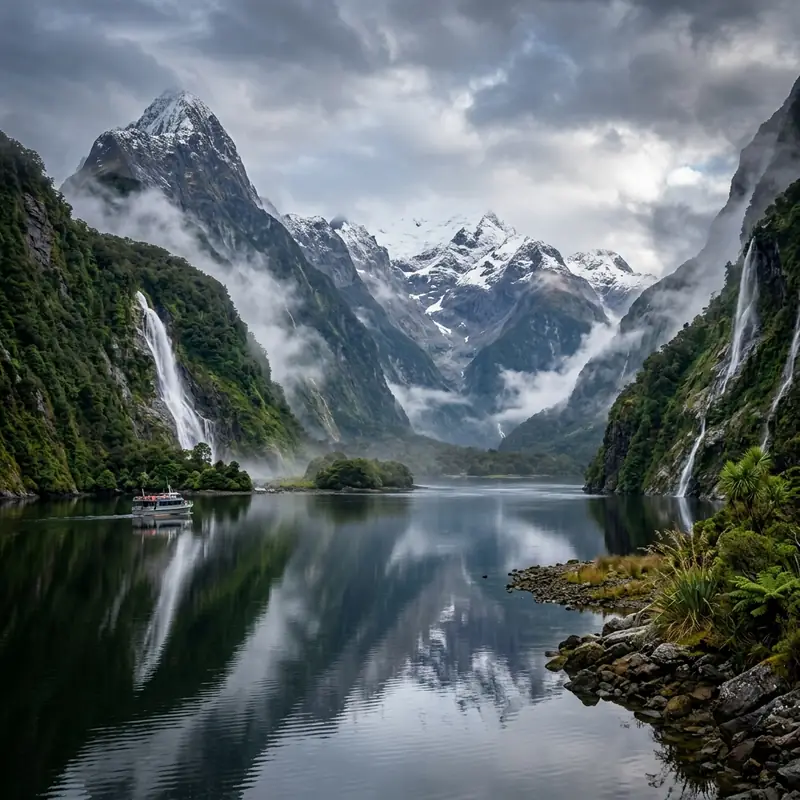
Milford Sound fiord with mountains reflected in water

Milford Sound

Milford Sound (Piopiotahi in Maori) is a fiord in Fiordland National Park, on the south-west corner of New Zealand's South Island. Carved by glaciers during the last ice age, it is approximately 15 kilometres long and up to 290 metres deep.

The dominant landmark is Mitre Peak — a 1,692-metre spike of rock rising directly from the water's edge. The fiord receives over 6,000mm of rainfall annually, one of the wettest places in New Zealand, which creates hundreds of temporary waterfalls cascading down the rock walls after rain. Stirling Falls (151m) and Bowen Falls (162m) flow year-round.

Getting There & Activities

  • Drive the Milford Road from Te Anau (2.5 hours) — one of the world's great scenic drives
  • Scenic flight from Queenstown — offers aerial views of the Fiordland wilderness
  • Cruise tours range from 1.5–3 hours; overnight cruises provide unique sunset and sunrise views
  • Kayaking tours available — highly recommended for getting close to the cliff faces
  • Milford Track (4 days, 53.5km) — one of New Zealand's nine Great Walks; must be booked months ahead

Practical Tips

Book ahead: Milford Sound cruises fill quickly, especially in summer. Rain enhances the experience — waterfalls multiply dramatically after rainfall. Sandflies are voracious at Milford; bring maximum-strength insect repellent. The fiord is best visited early morning before day-tour crowds arrive.

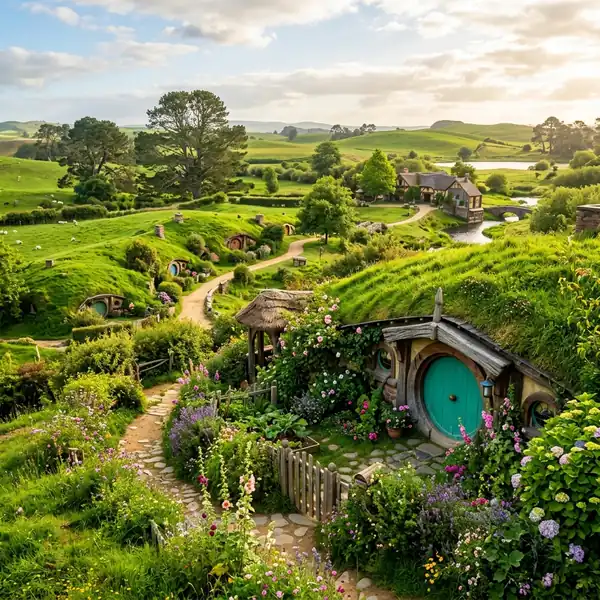
Hobbiton Movie Set with colourful round doors and gardens

Hobbiton Movie Set

Located on the Alexander sheep farm near Matamata in the Waikato region, Hobbiton is the fully intact movie set used in Peter Jackson's The Lord of the Rings and The Hobbit film trilogies. Unlike most movie sets, Hobbiton was rebuilt in permanent materials after The Hobbit filming — and is now maintained as a tourist destination year-round.

The rolling green hills of the Waikato countryside provided the ideal Shire setting. The farm was selected after extensive aerial survey of the North Island — the precise landscape Jackson envisioned for the Shire. Sheep still graze the surrounding paddocks as they did when Bilbo Baggins resided at Bag End.

Tour Options

  • Standard guided tour (2 hours): includes all 44 Hobbit holes, gardens, and Green Dragon Inn drink
  • Banquet Evening Tour: 4-hour experience with full feast in the Green Dragon
  • Breakfast and Lunch tours run seasonally
  • All tours depart from Shire's Rest in Matamata — no direct access to the farm independently

Practical Information

Book in advance — tours often sell out weeks ahead in peak season (December–February). The nearest large city is Hamilton (1 hour) or Auckland (2 hours). Combine with a visit to Rotorua (1 hour from Hobbiton) for an excellent North Island itinerary covering both geothermal wonders and the Shire.

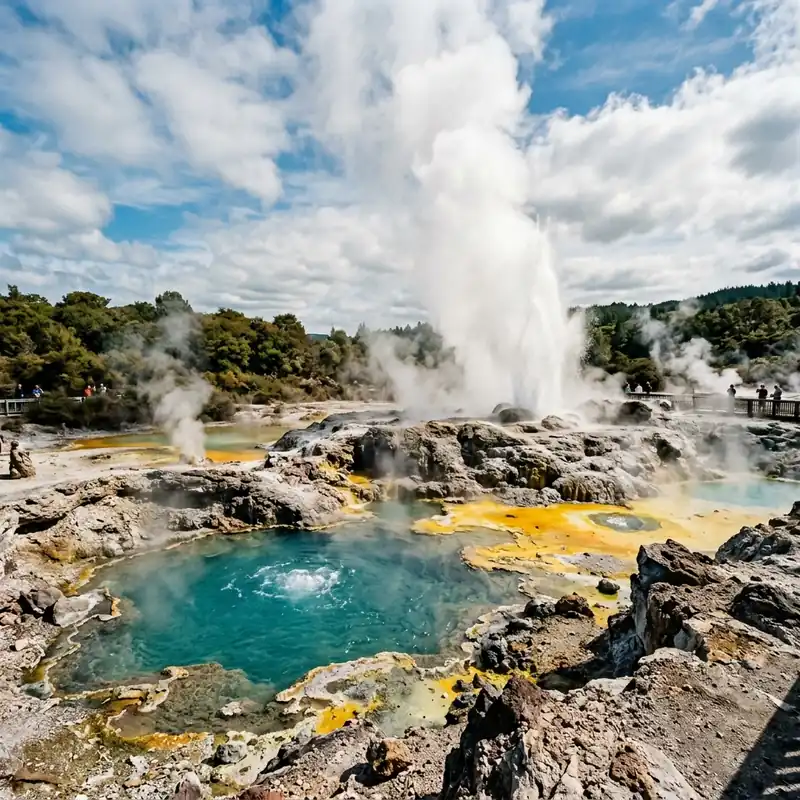
Rotorua geothermal park with erupting geyser

Rotorua Geothermal Valley

Rotorua sits at the heart of the Taupo Volcanic Zone, one of the world's most active geothermal regions. The entire city is built on a geothermal field — steam rises from cracks in footpaths, the lake shoreline bubbles, and the distinctive sulfuric smell permeates the air. Locals call it the "Sulphur City".

The city is also the cultural heartland of the Ngati Whakaue and Tuhourangi tribes of the Arawa iwi (tribe). Maori have lived in this geothermal valley for centuries, using the natural hot pools for cooking, bathing, and healing.

Key Geothermal Parks

  • Wai-O-Tapu Thermal Wonderland — most colourful: Lady Knox Geyser, Champagne Pool, Artist's Palette
  • Te Puia — largest active geyser (Pohutu), Maori Arts & Crafts Institute, living village
  • Hell's Gate — most active, with mud baths and spa treatments in natural thermal waters
  • Orakei Korako (Hidden Valley) — arguably the most beautiful geothermal park, via boat crossing

Adventure Activities

  • Mountain biking — Redwoods Whakarewarewa Forest has over 100km of purpose-built trails
  • Zorbing — roll downhill inside a giant inflatable ball (OGO, Rotorua)
  • White water rafting — Kaituna River Grade 5 rapids, including the world's highest commercially rafted waterfall (7m)
  • Luge — gravity-based go-kart from Skyline Rotorua with gondola access
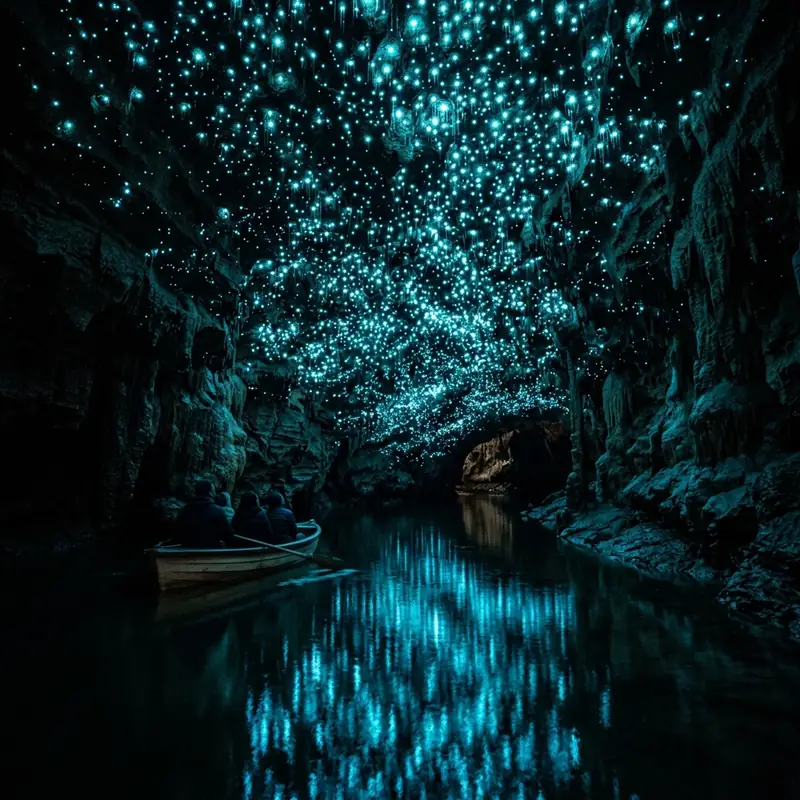
Waitomo Glowworm Caves with bioluminescent ceiling

Waitomo Glowworm Caves

The Waitomo Caves are a remarkable limestone cave system formed approximately 30 million years ago from the beds of a warm, shallow sea. Over millions of years, water erosion has carved vast chambers, underground rivers, and stalactite-filled passages through the rock.

What makes Waitomo unique is its population of Arachnocampa luminosa — the New Zealand glowworm. Found only in New Zealand, these tiny bioluminescent larvae produce a blue-green light from their tails to attract prey. Each individual is smaller than a matchstick, yet thousands together create an effect that genuinely resembles a starry night sky.

Cave Experiences

  • Glowworm Cave (45min guided tour) — culminates in the Cathedral Chamber boat ride
  • Ruakuri Cave (1.5hr) — larger cave, dramatic rock formations, underground rivers
  • Black Water Rafting Level 1 — 3-hour adventure through underground rivers on rubber tubes
  • Black Water Rafting Level 2 — 5-hour advanced trip with abseiling, rock climbing, and cave weta encounters
  • Lost World — 100-metre abseil descent into a 30-million-year-old cave system

Practical Tips

Book all cave tours in advance — the Glowworm Cave especially sells out in peak season. Waitomo is 80km from Hamilton and 3 hours from Auckland. Combine with Hobbiton and Rotorua for a comprehensive North Island itinerary. The caves are accessible year-round and temperature is constant at 12-13°C inside — bring a light layer.

Ready to Go?

Need Help Planning Your Visit?

Contact our team at Business Duo LLC for personalised trip planning advice and recommendations tailored to your interests and timeline.

Get In Touch